Property problemsProperty fixes and removals
Septic tank replacement: the binding rules, cost and who to call
In England, a septic tank that discharges straight to surface water, such as a river or stream, does not meet the general binding rules. GOV.UK says you must, as soon as possible, connect to a public foul sewer, replace the tank with a small sewage treatment plant, or install a drainage field so it discharges to the ground.
We read your enquiry and reply by email. Check a specialist's accreditation before work starts, using the guide below.
On this page
What it is
A septic tank treats wastewater where there is no mains sewer. The rules that matter here are the Environment Agency general binding rules, and they apply to England. Scotland, Wales and Northern Ireland have their own rules.
Under those rules, a septic tank must not discharge straight to surface water (GOV.UK gives a river, stream, estuary, lake, canal or coastal water as examples). If yours does, GOV.UK says you must have plans in place to put it right within a reasonable timescale, usually 12 months.
This page covers the three options GOV.UK gives, what affects the cost and who to ask first.
Is my existing septic tank compliant? A three-step check
- Find out where it discharges: to the ground, through a drainage field, or to surface water such as a river or stream. If you are not sure, GOV.UK says to get advice from a competent service engineer.
- Work out which set of rules applies. It depends on when the discharge started: before 1 January 2015, from 1 January 2015 to before 2 October 2023, or on or after 2 October 2023. Later discharges have extra rules, such as how close you are to a public foul sewer.
- Check the rules that apply to every discharge. These include: domestic sewage only; no more than 2 cubic metres (2,000 litres) a day to the ground, or 5 cubic metres (5,000 litres) a day to surface water; no pollution; a system that met the British Standard in place when it was installed; regular emptying by a registered waste carrier; and repairs when it is not in good working order.
If you cannot meet all the rules that apply to you, GOV.UK says you must connect to a public foul sewer or change your system so it meets them. Otherwise you must apply for a permit from the Environment Agency.
The survey and the work
A drainage specialist surveys the site, confirms how the existing tank discharges, and looks at the ground and the space for whichever option suits it.
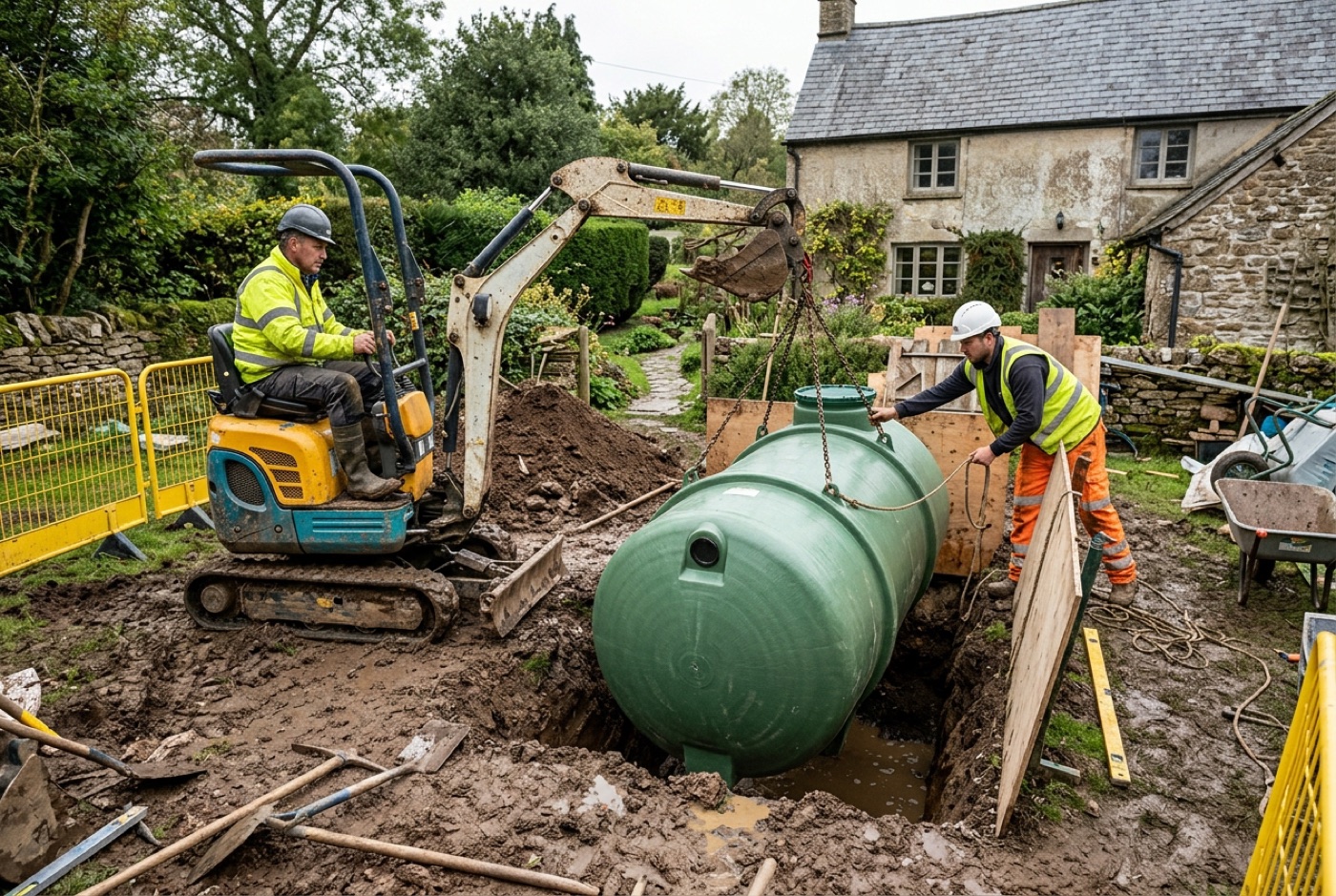
Installation involves digging, setting the new unit, connecting the pipework and commissioning. GOV.UK says you must have building regulations approval if you install a new septic tank or small sewage treatment plant, and you may also need planning permission.
It is a big job, so the cost depends heavily on access, the ground and the type of system needed.
What affects the cost
- Site survey
- Get a quote Confirms where the tank discharges, the ground and the right option.
- Sewage treatment plant and install
- Get a quote Driven by the system type, digging, access and any drainage field.
- Permit, if required
- Check with the Environment Agency You need a permit if you cannot meet all the general binding rules that apply to you (GOV.UK).
We have not found an official price source for this work, so we do not give a figure. The cost varies with the ground, access and the system type. Get a site survey and itemised quotes.
Who it is for
- Homeowners in England with a septic tank that discharges straight to surface water, which the general binding rules do not allow.
- Sellers whose drainage has come up in conveyancing, since a tank that does not meet the rules can hold up a sale.
- Buyers of a rural property who want the existing tank checked against the rules before completion.
The mortgage and sale angle
- If you buy or sell a property with a septic tank that discharges directly to surface water, GOV.UK says the buyer and seller should agree who will replace or upgrade it, as a condition of sale.
- When you sell, GOV.UK says you must tell the new owner in writing that a sewage discharge is in place, with a description of the system, where its main parts are, any changes made and how it should be maintained.
- A system that meets the rules, with its paperwork, removes a known obstacle for the buyer and their lender.
Your three options under the general binding rules
| Option | When it may fit | Permissions | Who to ask |
|---|---|---|---|
| Connect to a public foul sewer | Where there is a public foul sewer you can reasonably connect to. Once connected, the general binding rules no longer apply. | No permit needed once connected (GOV.UK). | Your local water company, which can tell you if there is a public sewer near your property (GOV.UK). |
| Replace the septic tank with a small sewage treatment plant | Where the discharge will still go to surface water. GOV.UK says you must use a small sewage treatment plant if you discharge to a watercourse such as a river or stream. | Building regulations approval for a new sewage treatment plant. You may also need planning permission (GOV.UK). | A drainage installer or competent service engineer. GOV.UK points to British Water's list of accredited service engineers and says there may be others. |
| Install a drainage field so it discharges to the ground | Where the ground can take the waste water. You then need to meet the general binding rules for discharges to the ground. | Appropriate building regulations approval, and planning permission where necessary (GOV.UK). | A drainage installer or competent service engineer, as above. |
Who to see first
Start with a company that installs and surveys septic tanks and sewage treatment plants, and ask it to look at where your tank discharges and what the general binding rules in England mean for your property. If this has come up during a sale, tell your solicitor at the same time, because GOV.UK says the buyer and seller should agree who deals with it as a condition of sale.
What to check before you agree any work: where the tank discharges (to the ground, or to surface water such as a river or stream); any paperwork you hold for the tank; and that any quote says what it includes and what it does not.
- GOV.UK: general binding rules, small sewage discharge to a surface water
- GOV.UK: general binding rules, small sewage discharge to the ground
VettedHome does not inspect or guarantee installers.
How to choose a specialist
- Use a drainage installer who knows the general binding rules and surveys the site before quoting.
- Confirm whether you need an environmental permit or building regulations approval, and who arranges each one.
- Get itemised quotes covering the survey, supply, digging, commissioning and any drainage field, and check the firm on Companies House.
Frequently asked questions
Do I have to replace my septic tank?
In England, if it discharges straight to surface water such as a river or stream, then yes, you must act. GOV.UK gives three options: connect to a public foul sewer, replace the tank with a small sewage treatment plant, or install a drainage field so it discharges to the ground. A tank that discharges to the ground through a drainage field may already meet the rules. A survey confirms which applies.
How much does a septic tank replacement cost?
There is no official price, and it varies widely with the ground, access and the system needed, so we do not give a single figure. A sewage treatment plant plus the digging and commissioning is a big job. Get a site survey and itemised quotes from a local drainage installer.
Can a septic tank stop my house sale?
It can hold one up. Drainage is checked in conveyancing, and GOV.UK says the buyer and seller should agree, as a condition of sale, who will replace or upgrade a tank that discharges directly to surface water. Dealing with it early avoids a last-minute obstacle.
Sources
- gov.uk: Septic tanks and treatment plants (general binding rules)
- GOV.UK: General binding rules, small sewage discharge to a surface water (Environment Agency, applies to England)
- GOV.UK: General binding rules, small sewage discharge to the ground (Environment Agency, applies to England)
- Environment Agency
Keep reading
Related on VettedHome
- Septic tank replacement checklist
- Selling with a septic tank: what to disclose
- Spray foam removal cost
- Open-cell vs closed-cell spray foam
- Cavity wall insulation guarantee claim
- Japanese knotweed and your mortgage: the RICS category system
- Woodworm and dry rot treatment guarantee
- Questions to ask before you pay for a survey or removal
- Does my flat actually need an EWS1?

Editor, VettedHome
Adam leads VettedHome's editorial coverage of UK home services. He is the founder and managing director of Muswell Rose, the commercial strategy and modern systems business behind a portfolio of UK information sites, and he researches and writes the plain-English guides that help homeowners choose between installers and trades, drawing on the standards set by the relevant bodies for each job, such as Gas Safe Register, NICEIC, MCS, TrustMark and the Property Care Association. He is clear about what to check before any work starts.
Last updated:
Get help
What’s happening with your septic tank?
Tell us what’s happening and we’ll get back to you with the next step. Free to use.
- It came up on a saleA buyer, survey or solicitor asked
- Something’s wrong with itSmells, slow drains or a backup
- It needs replacingOld tank or a new rule
- I’m not sure what I needWe’ll help you work it out
Free to use · Nobody pays to be listed · We tell you who gets your details